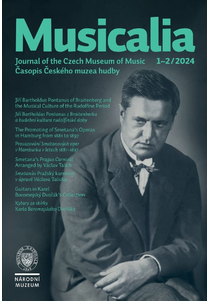
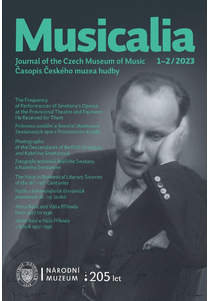
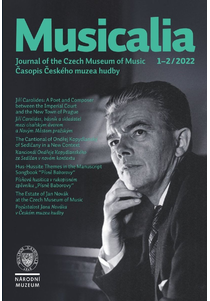
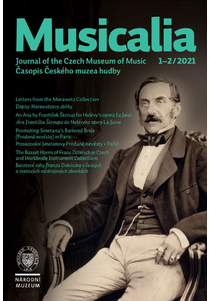
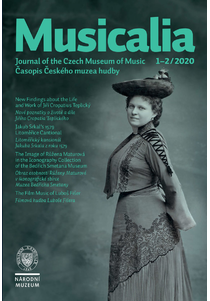
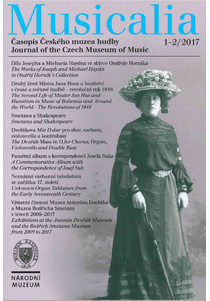
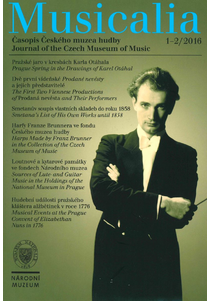
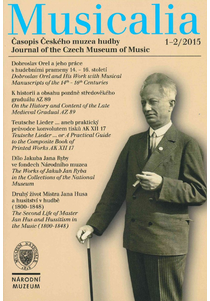
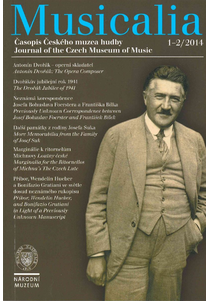
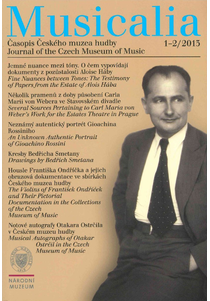
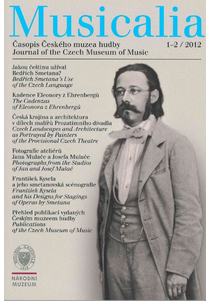
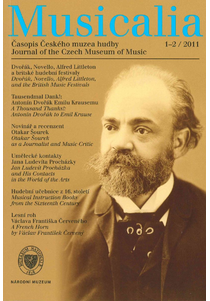
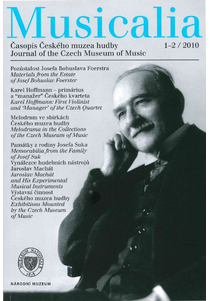
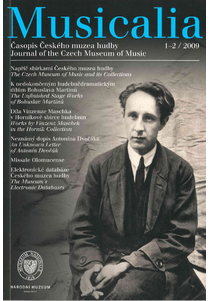
Latest Issue
ISSN: 1803-7828 (Print), 2533-5634 (Online)
Editor in Chief: Tereza Žůrková
The journal Musicalia was established in 2009. Its aim is to promote cutting-edge research, particularly in musicology and museology, and to create a space for the free exchange of academic knowledge throughout the scholarly community. It is a peer-reviewed periodical published once a year as a double issue. It focuses mainly on musicological studies while reaching out beyond this narrowly specialised field to strive for an interdisciplinary character. It publishes original scholarly articles and overviews, which are thematically centred around the collections of the Czech Museum of Music (Department of Music History, Department of Musical Instruments, the Bedřich Smetana Museum, the Antonín Dvořák Museum, and the Documentation Centre for Pop Music and New Media), and it presents the results of research on complete collections or individual items of significance. Attention is also paid to musical artefacts stored in other parts of the National Museum, as well as other related topics from beyond the institution itself. The journal informs about new additions to the collections of the Czech Museum of Music, introduces readers to the methods developed and applied by the museum in processing its collections, and presents means of accessing the collections through specialist publications or exhibitions. It also regularly reviews the latest literature in the field.
The structure of the journal is divided into two basic categories:
The main content consists of previously unpublished expert studies. These peer-reviewed studies meet the strict criteria for scholarly articles and include annotations. Each issue generally publishes 4–6 papers of this type with a length of about 3,000–6,500 words.
These are complemented by a second category of unreviewed contributions amounting to 1,000–1,300 words, namely, informative reports on exhibitions, publications, conferences, and other events organised by the Czech Museum of Music, focusing mainly on its current activities and future plans, and a review section, usually comprising two academic reviews of the latest literature on music and music history.
All papers are published in English and Czech. The reviewed studies are provided with a title, abstract, and keywords in English. All texts are available free of charge in the Open Access model through digital networks based on a unique DOI identifier. Individual issues can also be purchased in printed form via the National Museum’s online shop, its physical shops, or via mail order at publikace@nm.cz. The current issue of the journal and the archives of older issues are available at: https://publikace.nm.cz/en/periodicals/musicalia-journal-of-the-czech-museum-of-music-casopis-ceskeho-muzea-hudby.
Editor in chief:
- Mgr. Tereza Žůrková, Ph.D. (National Museum – Czech Museum of Music, CZ)
Editor:
- Mgr. Hana Ehlová, DiS. (National Museum – Czech Museum of Music – Bedřich Smetana Museum, CZ)
Editorial board:
- Prof. PhDr. Jarmila Gabrielová, CSc. (Charles University, CZ)
- Cav. Dott. Emanuele Gadaleta (National Museum – Czech Museum of Music, CZ)
- dr hab. Paweł Gancarczyk, prof. IS PAN (Polish Academy of Sciences, PL)
- Prof. Dr. Thomas Hochradner (Universität Mozarteum Salzburg, AT)
- Mgr. Václav Kapsa, Ph.D. (Czech Academy of Sciences, CZ)
- Jana Laslavíková, Ph.D. (Slovak Academy of Sciences, SK)
- PhDr. Milan Pospíšil, CSc. (Arts Institute – Theatre Institute, CZ)
- Prof. Angela Romagnoli (Università degli Studi di Pavia, IT)
- Janice B. Stockigt FAHA (University of Melbourne, AU)
- Mgr. Ludmila Šmídová, Ph.D. (National Library of the Czech Republic, CZ)
- PhDr. Dagmar Štefancová (National Museum – Czech Museum of Music, CZ)
- Mgr. Dr. Phil. Viktor Velek, Ph.D. (University of Ostrava, CZ)
- PhDr. Jana Vojtěšková, CSc. (National Museum – Czech Museum of Music, CZ)
- doc. Mgr. Vladimír Maňas, Ph.D. (Masaryk University, CZ)
- Mgr. Bc. Miloš Zapletal, Ph.D. (Silesian University in Opava, CZ)
The editors accept texts in Czech, Slovak and English and in electronic format. Submissions sent to the editors must be unpublished original works. They may be rejected by the editors prior to the review process if they do not meet the requirements for scope, originality, or clarity of language and style. The editors reserve the right to make any necessary amendments of form or language to the submissions before publication. Published contributions are not remunerated. Detailed information on publication ethics and the peer review process is discussed separately (→ Publication Ethics | → Peer Review).
Basic guidelines for authors:
- Topic proposals for texts (especially in the case of peer-reviewed studies) should be sent to the editors’ office well in advance, ideally in the last quarter of the year preceding the planned year of publication.
- The deadline for submitting the final version of a manuscript for the current issue is always no later than 31 March of the given year.
- Please send the texts in digital format only to the editor’s email address (tereza.zurkova@nm.cz), using Microsoft Word (*.doc, *.docx) and edited according to the following instructions:
- one standard font (Times New Roman), font size 12, left justified, no spaces between paragraphs, 1.5 line spacing, no word splitting, no embedded images or tables;
- footnotes should be in the same font, font size 10; for footnotes, use the appropriate automatic function in Microsoft Word; notes must be placed continuously below the text, not at the end of the paper;
- use italics only to distinguish the titles of compositions or other works; subheadings can be highlighted in bold;
- quotes should always be in quotation marks and italics – include shorter quotes directly in the text; longer quotes (e.g., a whole letter) must also be placed in a separate paragraph; additional quotation marks within the quote must be converted to single quotation marks (“quote ‘within’ a quote”); any interventions in the quote should be marked in square brackets and without italics; deletions are marked by an ellipsis in square brackets […].
- The length of the paper depends on the section to which it is assigned: studies should be submitted in the range of 3,000–6,500 words, informative texts and reviews in the range of 1,000–1,300 words. In justified cases, it is possible to publish texts shorter/longer than the established ranges, but only by agreement with the editors.
- Graphs, tables, images, and music notation should be submitted to the editors in separate files, with images in print quality (minimum 300 DPI) and in *.jpeg, *.jpg or *.tiff formats. The author of the paper is responsible for ensuring all copyright and publishing rights of the images and other figures are respected. Do not insert figures directly into the text, but indicate the approximate location of the figure by inserting the appropriate abbreviation (Fig. 1, Tab. 2, etc.) together with a full caption, and highlight them in yellow in the text.
- First names are always spelled out the first time they appear in the text, including in footnotes.
- The abstract and keywords (English translations will be provided by the editors) must be submitted together with the text, along with the author’s name, email contact and address of residence or workplace.
- Please indicate the dedication of the grant or project at the beginning of the text.
- Cite the sources and literature used in footnotes as they appear over the course of the text; do not append a list of references or bibliography to the end of the text. Follow the format for references and repeated citations as outlined below:
Monograph (1 author):
BERKOVEC, Jiří: Musicalia v pražském periodickém tisku 18. století. Praha: Státní knihovna ČSR, 1989.
(op. cit.): BERKOVEC, Musicalia v pražském periodickém tisku, op. cit.
Monograph (2 or more authors):
DOSTÁLOVÁ, Růžena – BŘEZINA, Aleš: Řecké pašije. Osud jedné opery. Korespondence Nikose Kazantzakise s Bohuslavem Martinů. Praha: Set Out, 2003.
(op. cit.): DOSTÁLOVÁ – BŘEZINA, Řecké pašije, op. cit.
Digital monograph:
KABELKOVÁ, Markéta: Václav Jan Tomášek 1774–1850. Tematický katalog skladeb [e-book]. Praha: Národní muzeum, 2024.
(op. cit.): KABELKOVÁ, Václav Jan Tomášek 1774–1850, op. cit.
Newspaper articles:
PAVEL, Petr: “Komická opera v kufru”, Rovnost, Vol. 89, No. 28, 2 February 1974, p. 3.
(op. cit.): PAVEL, “Komická opera v kufru”, op. cit.
Journal articles:
MIKULÁŠ, Jiří: “Trolda & Motejlek”, Hudební věda, Vol. 37, 2000, Nos. 3–4, pp. 231–238.
(op. cit.): MIKULÁŠ, “Trolda & Motejlek”, op. cit.
Book series:
Antonín Dvořák. Korespondence a dokumenty, ed. Milan Kuna, 10 volumes. Praha: Edition Supraphon, 1987–2004.
(op. cit.): Antonín Dvořák. Korespondence a dokumenty, op. cit.
Conference proceedings:
ROSSI-ŽÁČKOVÁ, Michaela: “Osecká hudební libreta”, in: 900 let cisterciáckého řádu. Sborník z konference konané 28.–29. 9. 1998 v Břevnovském klášteře v Praze, ed. Kateřina Charvátová, Praha: Unicornis, 2000, pp. 309–314.
(op. cit.): ROSSI-ŽÁČKOVÁ, “Osecká hudební libreta”, op. cit.
Encyclopaedia entries:
ŠTĚDROŇ, Bohumír: “Voříšek Jan Václav (Hugo)”, in: Československý hudební slovník osob a institucí, Vol. 2, Praha: Státní hudební vydavatelství, 1965, p. 908.
(op. cit.): ŠTĚDROŇ, “Voříšek Jan Václav (Hugo)”, op. cit.
Online sources:
BALDWIN, Mike: The Inventor of the Double-Action Pedal Harp with Fourchettes: Erard versus Groll [online], available at:
http://www.harpspectrum.org/historical/Erard%20versus%20Groll.shtml [accessed 25 January 2018].
(op. cit.): BALDWIN, The Inventor of the Double-Action Pedal Harp, op. cit.
Bachelor’s and master’s theses and dissertations:
VEJVODOVÁ, Veronika: Dvořákova poslední opera Armida, op. 115: Geneze a recepce. Dissertation. Masaryk University, Brno 2016.
(op. cit.): VEJVODOVÁ, Dvořákova poslední opera Armida, op. cit.
Referencing sources (general principles):
Manuscripts:
Title, institution, call No., folio.
Old prints:
SURNAME, First Name: Title. Location: printer, year.
Archival sources:
Name of institution, collection title, item or call number, box/book/folder/file number, (if applicable) date and place of publication, title or brief description of official registries and their time span, (for larger documents) page number.
For more information, please contact the managing editor of the journal:
Mgr. Tereza Žůrková, Ph.D.
Phone: +420 224 497 713, email: tereza.zurkova@nm.cz
The journal’s publication ethics are governed by the Code of Conduct of the Committee on Publication Ethics (COPE; http://publicationethics.org) and specify the rights and obligations of authors, editors, reviewers, and the publisher.
Rights and obligations of the author
Only texts based on original scientific research that show the author or authors’ own research contribution are accepted. The author is responsible for the originality of the work, and if the text makes use of any works and/or words by other authors, the submitting author is responsible for their proper citation. A text submitted to the journal’s editors may not be simultaneously offered for consideration in another periodical. The author of the paper is responsible for ensuring all copyright and publishing rights of the images and other figures are respected. The author actively cooperates with the editors while the text is being edited, up until the text is ready for print. The author is informed of any changes in the text made by the editors, with the exception of elementary spelling and stylistic issues.
After the review process, all reviews are provided to the author, along with any further suggestions for revisions by the reviewer or editor. The author has a minimum of 14 days to incorporate any comments from the reviewers. While the paper is being prepared, the author has the right to proofread the English translation of his/her text and then to proofread the typeset text (a minimum of 7 days for each proofreading). Corrections to the translation are made directly into the *.doc, *.docx file in the form of comments or tracked changes. Disputes regarding the translation are resolved between the author and the translator via the editors’ office. Corrections to the digital typeset text in PDF format are made by the author using the appropriate proofreading functions. This PDF proofreading can only be used to make minor formal and factual amendments, not substantial changes to the structure of the text. When the relevant issue of the journal is published, the author will receive one printed copy and an electronic version of his/her contribution in PDF format with a title page, table of contents, and imprint.
By sending the text to the editors’ office, the author grants the publisher the right to use the work within the meaning of Czech Act No. 121/2000 Sb., on Copyright and Rights Related to Copyright, as amended, that is, with an exclusive licence to use the work. At no stage of the manuscript review process does the author have a legal claim to publication of the submitted text. If the author discovers a significant error or inaccuracy in a published (or forthcoming) paper, it is the author’s responsibility to inform the journal editor immediately and to work with the editor to withdraw or correct the text.
Rights and obligations of the editors
The editors of Musicalia accept submissions that are relevant to the focus of the journal and have not been published elsewhere. The editors evaluate submissions with regard to their scholarly content and without regard to the race, gender, sexual orientation, religion, ethnicity, citizenship, or political views of the author. The editors may not disclose any information about the submitted text to anyone other than the author, reviewers, the editorial board, other editorial advisors, and the publisher. The editor may not use unpublished material contained in a submitted manuscript for his/her own research purposes without the express written permission of the author. The editor is obliged to ensure a fair and appropriate review process.
The editors have the right to reject a submitted paper prior to the review process if it does not meet the requirements for scope, originality, or clarity of language and style. The editors have the right to make linguistic changes to the text (especially elementary spelling and stylistic changes without the need to inform the author); more substantial stylistic and other amendments by the editors are made in the form of tracked changes or comments, which are forwarded to the author for authorisation. The English translation of the text is arranged by the editors’ office.
Texts submitted to the non-reviewed sections of the journal are not subject to peer review. The decision to publish this type of text is made by the managing editor in collaboration with the editorial board or other invited experts depending on the topic of the article. The final form of any given issue of the journal is decided by the managing editor in collaboration with the editorial board.
Rights and obligations of the reviewers
The review process is in a double-blind format. Reviewers undertake to approach the reviewed paper with the utmost objectivity and are obliged to immediately inform the managing editor in the event of a possible conflict of interest in relation to the reviewed text. They evaluate the originality and significance of the research contribution of the submitted study, the author’s work with sources and literature, and the stylistic and linguistic level of the text. Any objections should be duly substantiated and supported by relevant arguments or references to relevant literature. If the reviewers are aware that the text under review or some part of it has already been published or submitted for review in another journal, they are obliged to inform the managing editor of this fact. All aspects of the review process are considered confidential.
The reviewer will receive an anonymised paper for review and a review form from the editors. The reviewer is given sufficient time (usually 14–30 days) to conduct the review. The reviewer must treat the reviewed text as confidential and must not disclose it or its contents to others. The entire review process is described in detail in a separate section (→ Review Process). The reviewer’s review is remunerated financially according to the current possibilities of the publisher and also by the sending of the relevant issue of the journal upon publication.
Rights and obligations of the publisher
The publisher ensures the publication of the journal and its availability in Open Access form on the journal’s website at the publisher’s expense. The publisher endeavours to advance the journal’s transparency, expertise, and excellence by the selection of editors and by the selection and maintenance of the editorial board.
If a submitted manuscript is accepted for publication and subsequently published, the copyright passes from the author or authors to the publisher of the journal. This publisher’s copyright covers the exclusive right to reproduce and distribute published articles, including in the form of reprints, microfilms, electronic media (including the Internet), or any other type of reproduction or translation.
The editors accept submissions that are relevant to the focus of the journal and have not been published elsewhere. Submissions for peer-reviewed texts may be rejected by the editors prior to the review process if they do not meet the requirements for scope, originality, or clarity of language and style.
If the paper is accepted by the editors, it is sent to two independent reviewers for evaluation. The reviewers must not work at the same department as the author of the paper, and in the case of studies published under grants, the reviewer must not be involved in the grant in any way. Reviewers are selected by the journal’s managing editor, possibly in collaboration with the editorial board. The review process is in a double-blind format. The anonymity of the review process is ensured by anonymising the reviewed text (which the editors perform by removing all identifying information about the authors, both in the text and in the file metadata). The review process concludes in one of several outcomes: a) acceptance of the paper without reservations, b) acceptance of the paper with reservations (with the proposal of specific alterations), c) rejection of the paper.
The reviewer fills in the appropriate review form supplied by the editors. The main criterion of assessment is the originality and significance of the paper’s research contribution. The reviewer evaluates the text in terms of scholarly content and formal requirements and may specify necessary modifications of the text. In the event of two conflicting opinions, the editors will request a third opinion, which will be decisive. All reviews are subsequently provided to the author, along with any further suggestions for revisions by the reviewers or the managing editor. The author will be given a reasonable amount of time (minimum 14 days, maximum 30 days) to produce the final version of the text in agreement with the managing editor. Submissions that do not take into account relevant comments from reviewers and editors cannot be published in the journal.
Texts submitted to the non-reviewed sections of the journal (informative texts, reviews) do not undergo the review process – their acceptance or rejection is decided by the managing editor together with the executive editor, possibly also in cooperation with the editorial board.